LEAP Kinesiology and the Question: Does the Body Keep the Score . . . or Does the Brain?

by, Shannon Hawkins
*8 minute read*

Recently, a student asked me about the value of the iLEAP® (Life Enhancement Acupressure Program) or Brain Integration protocols developed by Dr. Charles Krebs. With recent changes to the training pathway, she wondered whether they were really worth rearranging her plans to attend. With the busy lifestyles and competing commitments we all juggle these days, that is a fair enough question, so I thought I’d share my thoughts on it as this question sits within a larger framework of trauma informed therapy and that ever present question for practitioners of all modalities, “How do I help my clients live their best quality of life?”
While I can't comment on how the LEAP Foundations curriculum is currently structured by the teaching body or how O'Neill College organises its learning modules, I can share my perspective as someone who has worked with these protocols in clinical practice for many years and reflect on where they sit within the broader landscape of psycho-emotional healing.
For many years, those of us working in kinesiology and other mind-body therapies embraced the phrase "the body keeps the score," popularised by Dr. Bessel van der Kolk. This simple phrase illustrates such profound knowledge about the relationship of the present physical body and it’s emotional history, it came a ‘catch-all’ statement in many conversations. Dr Van der Kolk’s work highlighted how traumatic experiences can continue to influence the body long after an event has passed, affecting physiology, emotions, behaviour and health. As practitioners who work closely with subconscious emotional responses, the nervous system and the body's energetic communication systems, this resonated deeply with what we observed in clinic.
More recently, advances in neuroscience have shifted the conversation. Research in affective neuroscience, neurobiology and trauma has increasingly focused on how traumatic experiences alter functional brain networks, particularly those involved in threat detection, emotional regulation, memory, attention and survival responses. Researchers such as Joseph LeDoux, Stephen Porges, Ruth Lanius, Lisa Feldman Barrett and others have contributed to our understanding that trauma involves changes within interconnected neural circuits that continually influence what we experience in the body.

So which is correct? Does the body keep the score, or does the brain?
From my perspective as a Functional and Neurological Kinesiologist, the answer is simply both.
The apparent disagreement often reflects an old philosophical division between mind and body, a separation dating back to René Descartes. Modern neuroscience increasingly recognises that this distinction is artificial. The brain and body exist as one integrated, constantly communicating system. Brain circuits shape physiology, while bodily sensations continuously influence brain activity. Neither exists independently of the other. Rather than viewing trauma as being "stored" exclusively in the brain or the body, it may be more accurate to say that traumatic experiences become embedded within an integrated neurophysiological system involving the brain, autonomic nervous system, endocrine system, immune system and the body's ongoing sensory experience.
This is one of the reasons I continue to value iLEAP and Brain Integration kinesiology. We work through the conscious physical body while engaging the subconscious neurological, emotional and energetic systems simultaneously. By supporting regulation of the nervous system, reducing stress responses and facilitating new patterns of integration, we are working with both the body's physiological experience and the neural circuits that help generate it.

So, Where Do the iLEAP and Brain Integration Protocols Fit?
This is where I believe Dr. Charles Krebs made an exceptional contribution, one that I am personally grateful for every working day in my kinesiology practise. Long before many of today's discussions around brain-based trauma therapies became mainstream, Dr. Krebs recognised the importance of understanding functional brain organisation alongside the body's physiological and energetic responses. His work provided practical maps of neurological systems that could be integrated into kinesiology practice. Rather than treating symptoms in isolation, the Brain Integration protocols help practitioners consider how specific neural networks, emotional processing, cognition, movement and survival responses interact as one integrated system. For me, this is where the real strength of these protocols lies.
Now Let's Look Specifically at Brain Integration Level 2 and LEAP Foundations Levels 4 & 5
These courses move beyond introductory neurological concepts into practical protocols for working with some of the deeper functional systems involved in human behaviour, emotional wellbeing and the physical expression of stress. We learn about the neural networks involved in emotional modulation, emotional expression and even the internal experience of emotion. Rather than needing a completely different approach for every individual emotion, we begin to work with the underlying systems responsible for regulating emotional intensity, resilience and adaptation.
We learn about the neural circuits involved in strong emotional experiences, how our upbringing and culture can shape the way we express and regulate emotion, and how both conscious and subconscious processes work together to modulate feelings that may sometimes feel overwhelming or even unsafe. This develops our understanding of the neurology of emotion in a way that allows us to help our clients develop greater awareness of what may be making it difficult for them to manage their emotions, express them in the way they want to, or respond effectively when they experience these moments of emotional ignition.

And this is where I find the work particularly interesting. Sometimes the patterns affecting a person's emotional responses are so deeply subconscious that they are completely outside the person's conscious awareness. A client may know what they are feeling, but have very little understanding of why their response is so strong, why they can't seem to stop repeating a particular pattern, or why their response doesn't seem to match what they consciously believe. The neurological frameworks we learn give us another way of looking at these patterns.
At the same time, our work remains holistic. We are not simply sitting outside the system and analysing neural circuits. Through the kinesiology process, we can work with the physiological and energetic expression of stress associated with these patterns. When intense stress begins to release, clients may experience this in a variety of ways. For example, they may simply feel a sense of relief, decompression or even a reduction in physical tension. For me, this is one of the beautiful aspects of working with the whole person rather than trying to separate emotional experience from the physical body.
The Neurology of Thought
We also explore the neural circuits underlying thought processing. While many of these protocols were originally developed with the aim of supporting cognitive function and learning, the impact that improved cognitive function can have on a person's emotional life should not be underestimated.
When we are overwhelmed by repetitive thoughts, cognitive overload, rigid thinking patterns or limiting beliefs, our emotional world is affected too. It can become much harder to regulate ourselves, see different perspectives, make decisions or respond rather than react. In this aspect of the course, we learn how to work with neurological patterns associated with repetitive thinking, cognitive overload, limiting beliefs and difficulties with mental flexibility. These protocols can be particularly valuable for clients who describe themselves as "not thinking clearly," feeling mentally stuck, unable to switch off their thoughts, or unable to see beyond a particular way of thinking. Sometimes changing the way we think or simply improving cognitive processing by identifying and releasing energetic stresses held in these circuits creates room for emotional change as well.

Working with the Deeper Survival Systems
Another area I find incredibly valuable is the opportunity to expand our ability to work deeply with the influence of the survival systems on the physical experience of the body. This gives us a different level of inquiry. Rather than simply observing that a client is holding tension, we can explore the neurological and physiological patterns associated with that tension. We can ask:
What is maintaining this response?
What system is involved? Where is the energetic imprint affected?
What might be keeping the nervous system in a state of activation?
For example, we can explore the relationship between stress and muscular tension, digestive function and the autonomic nervous system, or the way a persistent stress response may continue to influence the body's physiological state.
Modern neuroscience recognises the important role of the brainstem, midbrain and other evolutionarily older neural structures in defensive behaviours, arousal, threat detection and automatic survival responses. These systems can operate largely outside conscious awareness, which helps explain why a person can intellectually understand that they are safe while their body continues to respond as though something is wrong.
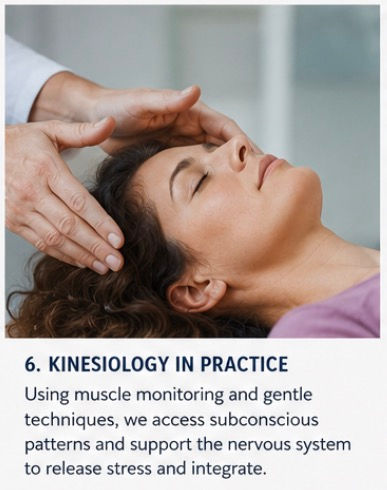
These deeply established patterns can be remarkably persistent, particularly when they have developed early in life or have been reinforced repeatedly over time. Importantly, the nervous system remains capable of change throughout life. Neuroplasticity does not simply disappear as we get older, although changing deeply established patterns generally requires repetition, consistency, regulation and time. The LEAP protocols provide structured ways of engaging with these survival systems within a broader neurological framework.
For me, this is one of the areas where the work becomes particularly powerful: we are not asking a client to simply think differently about a survival response. We are energetically exploring the neurological systems involved in the response and working with the body and nervous system at the same time.
Why Explore Vestibular and Cerebellar Integration ?
The course also takes us into functions of the Vestibular System and deep Cerebellar Circuits. This is important because the way we experience the world is not purely emotional or cognitive. Our nervous system is constantly processing information about where we are in space, how we are moving, whether we are balanced, where our body is in relation to our environment and whether that environment feels safe.
Experiences of significant stress and trauma can influence posture, orientation, movement, coordination, balance and our overall sense of safety within the environment. Changes in the way a person moves through space can therefore be part of the broader pattern of how their nervous system is organising its response to the world.

This is where the neurological and emotional aspects of the work can become fascinatingly intertwined. We may begin working with a client around an emotional experience and discover that the pattern also has a physical expression in the way they hold their head, move their body, orient themselves or coordinate movement. Conversely, changes in sensory and motor integration can influence how a person experiences themselves within their environment.
These specialised kinesiology processes give us another way to work with these patterns in a gentle and highly individualised way. They can be relevant when working with functional patterns involving posture, movement efficiency, balance, coordination and the integration of physical, emotional and cognitive experiences which makes them highly useful and effective tools in our practitioner toolbox.
And Then We Go Even Deeper Exploring Glial Cells
Finally, one aspect that particularly distinguishes the later Brain Integration work for me is the incorporation of glial cell function. Most people learn about neurons when they study the nervous system. Glial cells, however, are essential to the health, support, maintenance and regulation of neural networks. They are not simply passive "support cells"; they play important roles in neural communication, metabolic support, immune activity, myelination and the broader functioning of the nervous system. With these later protocols, we begin considering this level of neurological organisation and incorporating an understanding of glial function into neurologically focused balancing procedures.

For me, this takes the work into another layer entirely. We move from considering the person's experience at the level of emotion, thought, movement and larger neural networks, towards considering the microarchitecture that supports those networks. And this is perhaps one of the reasons I continue to value these courses so highly.
They give us progressively deeper maps of the human system—from emotional and cognitive experience, through survival systems, sensory and motor integration, down into the cellular environment that supports neurological function. We are not required to choose between working with the emotions, the mind, the nervous system or the physical body. We can learn to work with the relationships between them and this is a truly holistic perspective.
And ultimately, that is what I believe makes Brain Integration and the LEAP protocols so valuable: they give practitioners increasingly sophisticated ways of seeing the human being as an interconnected system, rather than as a collection of separate parts.
What Professional Kinesiologists Will Learn as Participants of This Course
Now getting doen to the nitty-gritty, more technical side of this blog, for those interesterested in doing Brain Integration Level 2 and LEAP Foundations Levels 4 & 5, this course includes practical protocols for working with:

The Three Pillars Framework
Emotional Modulatory Circuits
Mental Modulatory Circuits
Periventricular Survival System Circuits
Vestibular System Pathways
Major Integrative Centres and Integrative Pathways
Cerebellar Circuits, including physical, emotional and cognitive integration
Brain Integration processes incorporating glial cell function and their contribution to healthy neural communication
For me, these protocols remain some of the most clinically valuable tools I have learned in almost two decades of practice. They provide a framework that honours both modern neuroscience and the lived experience of our clients, recognising that healing does not occur solely in the brain or solely in the body, but within the integrated human nervous system as a whole. Seeing this every day in my work with clients has been a blessing that I continue to value. I hope that in whatever path you are on, your wholeness is acknowledged, even in those times when you may feel like you are existing in pieces. The brain and body are in constant conversation because they are one and when we address both the neurological circuits and the somatic experience true healing and lasting change become possible.


Comments